
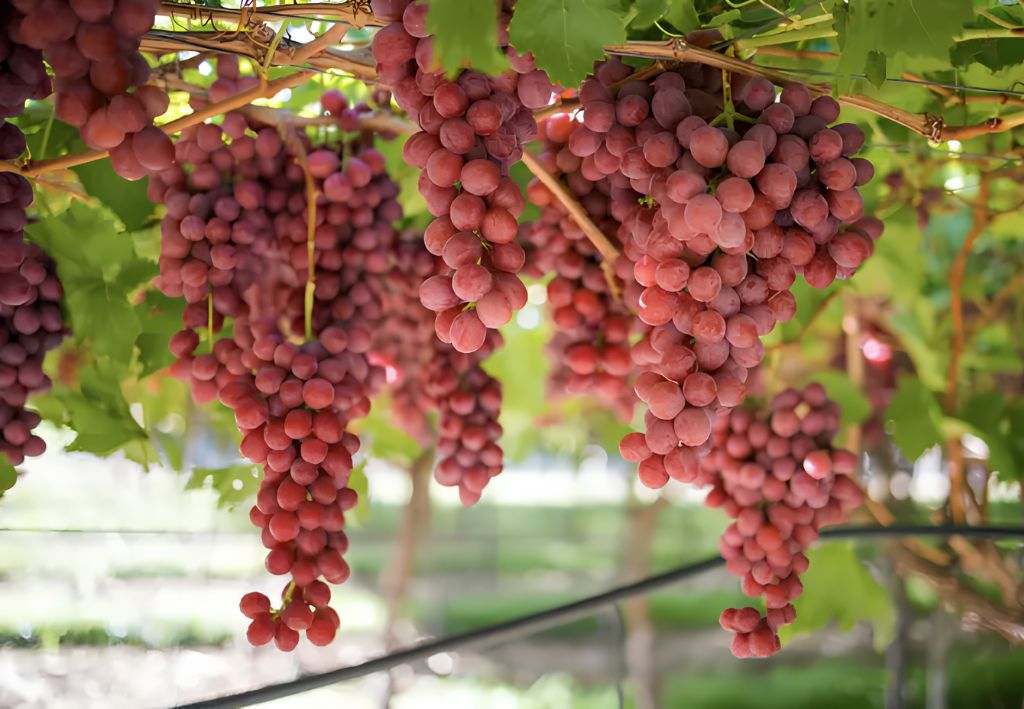
South Africa remains one of the world’s leading table grape exporters despite a shrinking production footprint, but increasing global supply, changing trade conditions, and intensifying competition are putting greater emphasis on productivity, quality, and market diversification.
Global table grape production continues to expand even as the area under vines contracts, according to the Global Grape Group’s (GGG) Global Table Grape Report 2026.
The report shows that global table grape production increased by 17% over the past decade, while the planted area declined by 6%.
It adds that shrinking hectarage does not necessarily translate into lower supply or reduced competition, as improved genetics and production practices have enabled growers to produce more fruit from less land.
Global production reached an estimated 34,4 million tons in 2025 from just under two million hectares. Asia dominated production with 24,9 million tons, followed by the Americas at 4,3 million tons and Africa at 3,1 million tons. Europe produced around 1,9 million tons and Oceania 210 000t.
The expansion in production is emerging as one of the table grape industry’s central challenges. According to the report, supply is growing faster than demand, increasing the need for the industry to stimulate consumption rather than relying primarily on gaining market share from competing origins.
China reshapes global trade
China has become an increasingly important player in international table grape trade. It was the world’s largest producer in 2025, producing an estimated 15 million tons, and the largest exporter, with almost 802 000t.
Peru ranked second among exporters with around 742 000t, followed by Chile (478 000t). South Africa exported 427 100t, placing it sixth in the report’s global export ranking, which also includes re-exporting trading hubs such as the Netherlands.
China’s growing influence is particularly significant for Southern Hemisphere exporters. Its expanding domestic production is reducing import requirements at certain times of the year, while simultaneously increasing exports into other Asian markets.
Chinese table grape imports fell from about 195 000t in 2021 to 106 000t in 2025. South African shipments to China dropped from about 10 417t to just 2 383t over the same period.
The GGG identifies increasingly intense competition in Asia as one of the major trends facing the industry, saying imported grapes will have to meet increasingly demanding quality requirements to remain competitive.
More grapes from fewer hectares
Productivity is becoming an increasingly important measure of competitiveness.
The report says improved genetics are delivering gains in eating quality, productivity, and shelf life, but simply planting newer licensed varieties does not guarantee commercial success. Genetics must be appropriate for the production region, harvest window, and intended market, while returns must justify production and royalty costs.
Premium green seedless grapes are showing particular commercial strength, although the report cautions that increasing production means today’s favourable returns are not guaranteed tomorrow.
Timing is becoming almost as important as quality. Concentrated arrival periods can depress prices even for high-quality fruit when competing origins converge on the same market window.
The report consequently argues that future profitability will increasingly depend on aligning quality, volume, and timing rather than simply maximising production.
Weather-related risks and rising production costs add further pressure. Labour, packaging, logistics, royalties, inputs, and destination-market costs are all squeezing margins, while adverse weather can alter yields, fruit quality, and harvest timing. A strengthening El Niño is highlighted as an additional uncertainty for the coming production cycle.
Sub-Saharan Africa punches above its weight
According to the GGG, sub-Saharan Africa (SSA) remains a relatively small producer in global terms, accounting for 430 447t from 25 504ha in 2025.
This represented about 14% of Africa’s total table grape production of just over 3,1 million tons, with Northern Africa accounting for the balance of 2,7 million tons.
Production in SSA nevertheless increased from 414 659t in 2021 to 430 447t in 2025, despite the planted area declining from 26 278ha to 25 504ha.
South Africa dominates commercial production in the subregion. It produced 365 642t from 19 343ha in 2025, compared with Namibia’s 51 267t from 2 362ha. Tanzania produced 5 820t, Madagascar 3 470t, and Ethiopia 3 370t.
Therefore, South Africa accounted for roughly 85% of SSA’s table grape production.
The regional figures mirror the global trend towards producing more from a smaller footprint. South Africa’s planted area declined from 20 378ha in 2021 to 19 343ha in 2025, while production increased from 349 798t to 365 642t.
South Africa increases output despite smaller footprint
The South African table grape industry recorded a solid 2025/26 season despite the longer-term contraction in hectares.
According to the South African Table Grape Industry’s (SATI) contribution to the report, warmer weather resulted in an earlier-than-usual start to the season and brought peak harvesting and export volumes forward.
Final inspection volumes reached roughly 81,3 million 4,5kg-equivalent cartons, compared with 78,9 million cartons in 2024/25. Exports reached 78,3 million cartons, marginally higher than the previous season’s 78,2 million.
The national production footprint remained stable at 19 343ha across five production regions. SATI attributes the gradual improvement in productivity partly to the replacement of older vineyards with higher-yielding, new-generation cultivars.
Volumes inspected for export have consequently increased at a compound annual growth rate of 2% over the past nine years.
The country’s northern provinces packed 5,9 million cartons for export, 23% more than in the previous season. The Orange River region delivered a record crop of 26,8 million cartons, up 7,2%.
The Berg River region packed about 20 million cartons, up by 2,5%, while Olifants River’s 4,2 million cartons represented a decline of about 5%.
The Hex River region packed 24,4 million cartons, down 3,5%, largely as a result of rainfall during the latter part of the season.
Europe remains South Africa’s anchor market
Europe and the UK were, by far, South Africa’s most important destinations in 2025/26, together accounting for 83% of exports.
Europe received 52,2 million cartons, up 16% year-on-year. However, greater volumes from several other Southern Hemisphere suppliers contributed to periods of price pressure.
Exports to the UK declined by 6% to 13,5 million cartons.
Agronometrics trade data contained in the GGG report underline South Africa’s dependence on European markets. Shipments to the Netherlands rose from about 205 711t in 2024/25 to 255 244t in 2025/26, while exports to the UK were broadly stable at around 67 644t.
Total South African exports to Europe increased marginally from about 422 977t to 427 100t.
Tariffs hit US hard
Conditions were considerably more difficult in North America.
SATI said in the report that the 30% US tariff on South African products, imposed during the 2025/26 export season, compared unfavourably with the 10% tariff faced by competitors such as Chile and Peru.
Combined with shipping and logistics constraints, this contributed to a sharp decline in South African grape shipments to the US, from 2,2 million cartons in 2024/25 to 357 580 in 2025/26.
Exports to Canada also declined, dropping from 5,3 million cartons to 3,2 million.
Geopolitical instability similarly affected Middle Eastern trade, with exports to the region, including Israel, declining from about 5,2 million cartons to 4,3 million over the same period. The report cites war in the region and the closure of the Strait of Hormuz among the disruptions affecting the market.
New Asian market opportunities
The setbacks in some traditional markets have increased the significance of new market access opportunities.
South Africa gained temporary tariff-free access to China during the season and exported table grapes to the Philippines for the first time after securing market access in 2025.
An export protocol with the Republic of Korea was also concluded and published in February 2026, opening the way for commercial shipments from the 2026/27 season once the remaining administrative processes are completed.
According to the GGG, South Africa now has access to 17 of the world’s 18 largest table grape markets.
The challenge is consequently shifting from simply gaining access to retaining markets and creating demand.
This fits the wider warning contained in the global report: increasing productivity alone will not guarantee producer returns if consumption fails to keep pace.
The GGG argues that market diversification needs to be accompanied by consumer engagement, promotion, and retail partnerships. Simply redirecting surplus grapes to alternative destinations risks moving oversupply from one market to another rather than solving the underlying imbalance.
For South African growers, the global figures point to a similar conclusion. The country’s ability to produce more grapes from fewer hectares has strengthened its international competitiveness, but rising global production means future returns are likely to depend increasingly on marketable yield, consistent eating quality, precise timing, and access to a broader mix of profitable markets.
The GGG report itself cautions that differences in data availability, definitions, and reporting methodologies between countries mean its figures should be regarded as the best available approximation rather than a definitive accounting of the industry.











Add comment